Bottom line: Do not try to display every stop. Choose the few cities that changed the shape of the journey.
Why it works: A consistent map series gives very different memories one visual language.
Try this: Write down five places, remove the two that only represent short visits, and design the remaining three as a set.
Settling down after a long period of travel can feel unexpectedly strange. The practical relief is real—a familiar bed, a real desk, books that do not have to fit in a bag—but the blank room can make the previous year feel distant almost immediately.
The temptation is to unpack every ticket, photograph, and small object at once. That usually creates a crowded record of movement rather than a home. Editing is what turns the journey into an interior.
Choose chapters, not check-ins
Start with the places where daily life developed. The city where you learned a morning route matters differently from a weekend stop. So does the place where work changed, a friendship formed, or a future plan became clear.
Three maps are often enough to describe a long year. They can mark a beginning, a turning point, and the place that finally felt like arrival. If one city holds most of the story, use a single large map and let smaller objects carry the rest.
Build one visual sentence
Different cities have different street densities, coastlines, and shapes. That variation is the reason the set is interesting. Keep the presentation consistent so the geography can do the talking.
Use the same:
- poster size and orientation;
- frame material and mat width;
- title and subtitle structure;
- map theme or a tightly related palette;
- spacing between pieces.
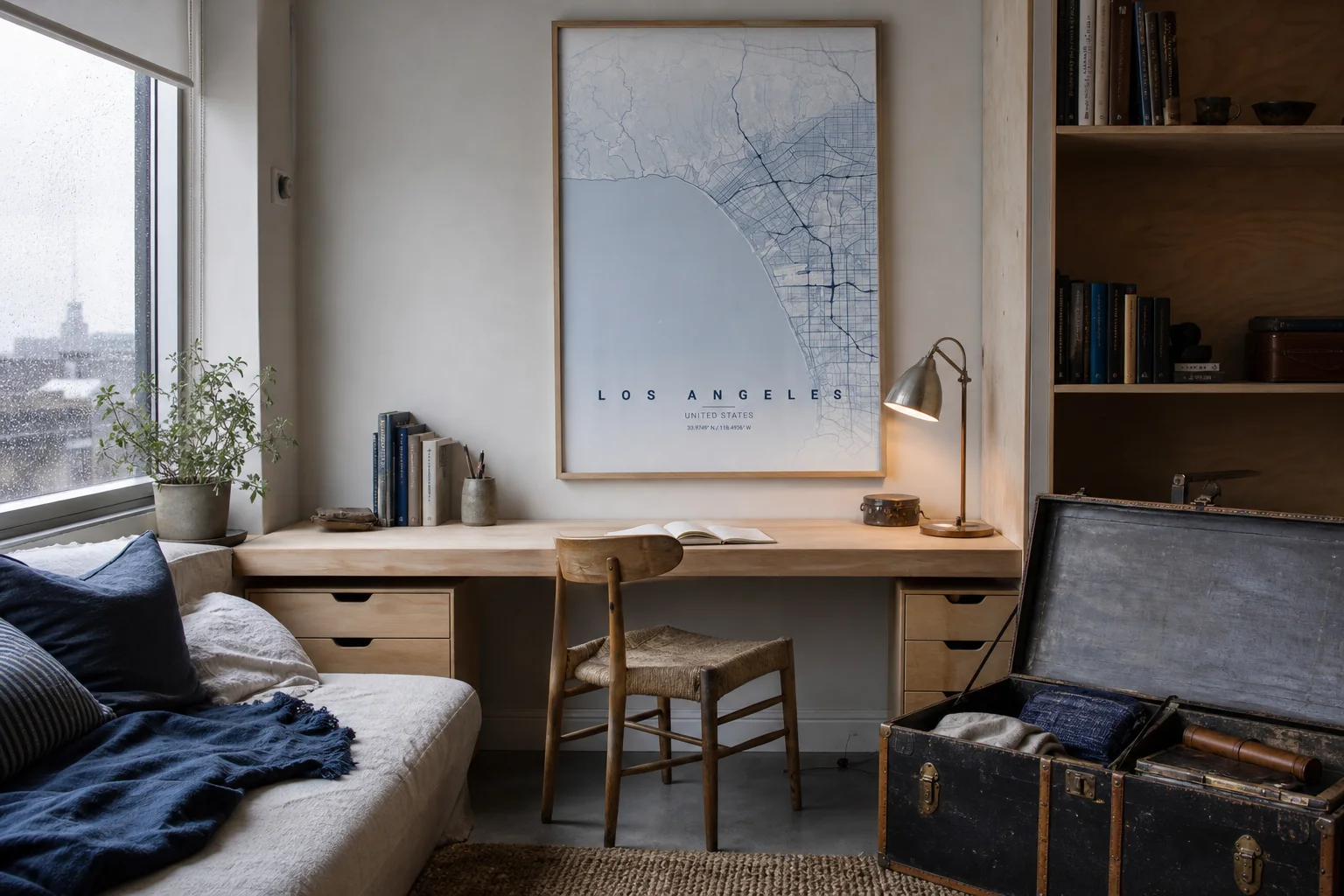
The Los Angeles loft above uses a quiet blue map, pale timber, travel-worn leather, and soft linen. The trunk is still present, but it has become storage rather than the center of the room. The map marks the transition from movement to residence.
Place the map where the new routine happens
A travel map does not have to live in a hallway gallery. Put it near the routine that belongs to the new chapter: above the desk where remote work continues, beside the table where friends now gather, or opposite the bed in the first stable apartment.
That placement changes the object from a souvenir into part of daily life. It becomes something noticed in passing rather than a display that needs an explanation.
Keep personal evidence in the details
Maps provide structure; small objects provide texture. One book, a ceramic cup, or a worn notebook can make the room feel specific without asking every memory to compete on the wall.
The goal is not to prove how many places were visited. It is to make room for what the journey changed. A carefully chosen city map can hold that meaning quietly, even when no one else knows the full story.
Start with the city that became a chapter, then let the rest of the room stay calm.