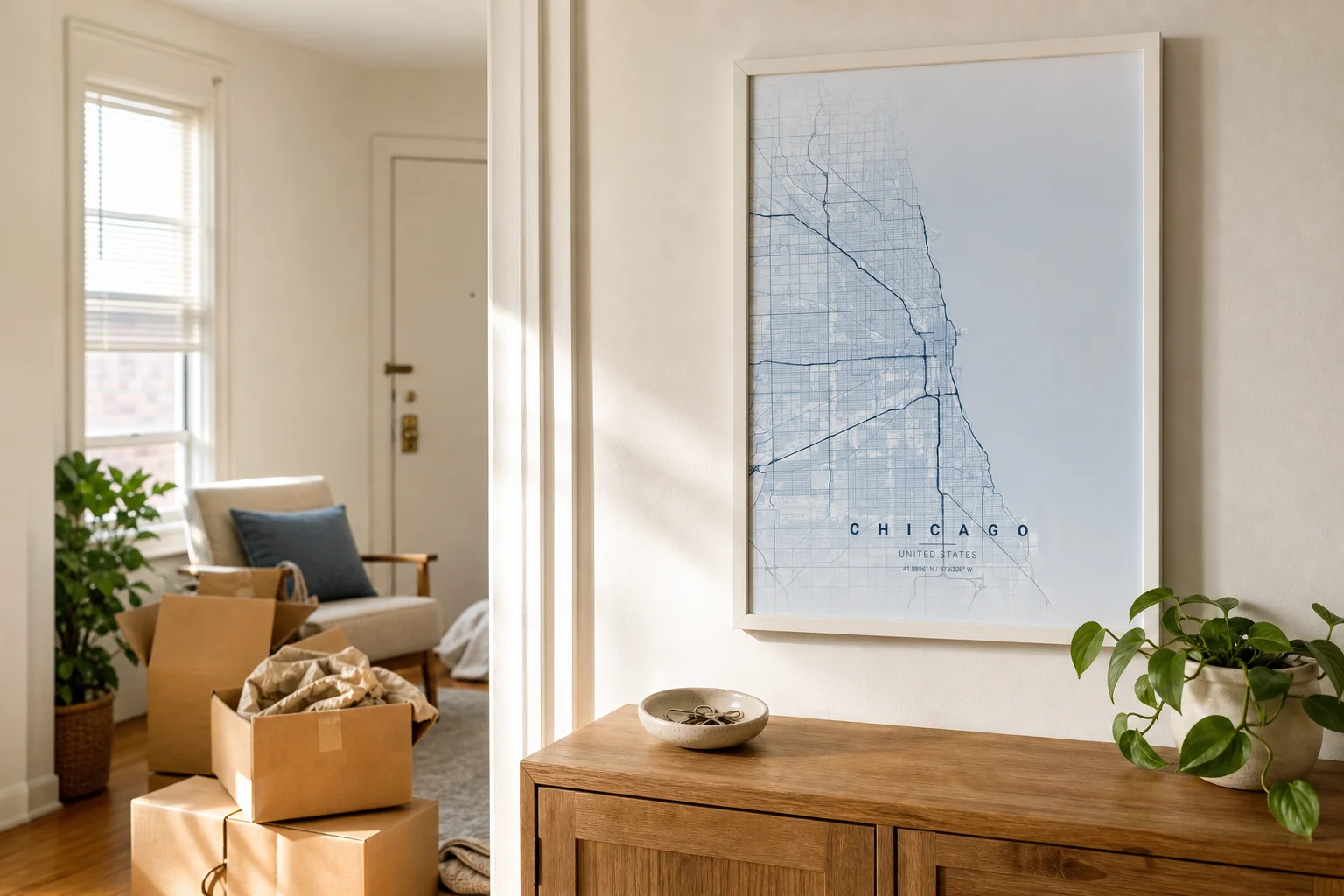
Bottom line: Hang one meaningful piece early. It gives the new room a center before everything else is decided.
Why it works: A hometown map is personal to you and abstract enough to live comfortably with new furniture and colors.
Try this: Map the area you actually knew—not the whole region—and hang it near the first daily ritual of the new home.
Moving creates a brief period when every object feels provisional. The chair is wherever it fit through the door. The books are still in boxes. Even familiar things look different against an unfamiliar wall.
One deliberate piece of art can change that faster than a perfectly styled room. A hometown map works particularly well because it carries memory without asking the new apartment to imitate the old one.
Choose the geography you remember
The meaningful place may be smaller than the city printed on an address. Think about the streets you walked, the bus line you waited for, the river crossing that marked the way home, or the park that divided one neighborhood from another.
A tighter radius makes those details visible. A wider radius is better when the relationship is with the whole city—its shoreline, overall grid, or distance between important neighborhoods.
The Chicago map above keeps the lake edge and strong north-south structure legible. In the half-unpacked apartment, that familiar geometry is enough to make the room feel claimed.
Let the new room choose the treatment
The map should remember the old place while belonging to the new one. Choose the theme and frame from the apartment you have now.
For a light rental with white walls and oak furniture, a pale monochrome map avoids making the room feel smaller. A dark midnight or noir treatment can bring depth to a larger wall. Terracotta and warm-beige maps soften rooms with linen, leather, and natural timber.
Frame material matters as much as map color. Repeat one finish already in the room, even if it appears only in a chair arm or a small console. That repetition makes the piece feel placed rather than merely hung.
Hang it where arrival happens
An entry hall, the wall beside a key bowl, or the view from the front door are natural locations for a hometown map. The piece becomes part of leaving and returning—the exact routine that slowly makes a new address feel like home.
It can also work above a desk if the move came with a new job, or near the dining table if building a new circle is the important part of the chapter. Placement should follow the story, not a generic rule about filling the largest wall.
A useful moving-away gift
If the poster is a gift, ask for the recipient’s real neighborhood and take cues from their new room. Avoid adding a long message directly to the artwork. The city, a short subtitle, and coordinates are usually enough.
The result can hold sentiment without looking like a souvenir. To a visitor, it is a composed map. To the person unpacking, it is a familiar route waiting on the wall.
Create a hometown map before the last box disappears and the memory becomes less precise.