Bottom line: The route tells more of the race story than the medal alone.
Why it works: A line across a city makes distance, turns, neighborhoods, and the finish visible at once.
Try this: Load the activity, simplify the surrounding roads, and give the start and finish enough space before choosing the final print size.
A finisher’s medal is an important object, but it is a small one. It cannot show the early miles when the pace felt easy, the bridge that arrived at the wrong moment, or the long final avenue that seemed to move farther away.
A route map places the achievement back inside the city. The line is not abstract fitness data; it is a record of how the day unfolded through real streets.
Start with the activity trace
Connect a Strava activity or upload the GPX file from the race. Check that the line begins and ends where expected and that there are no obvious recording jumps.
The route should determine the map crop. Give it room to breathe rather than forcing the entire city into the frame. A course that travels in one long direction may need a different orientation from a compact loop.
Let the base map support the line
The street network provides context, but it should not compete with the course. Reduce minor-road detail if the route crosses a dense center. Use stronger contrast for a complicated line and a quieter treatment for a simple loop.
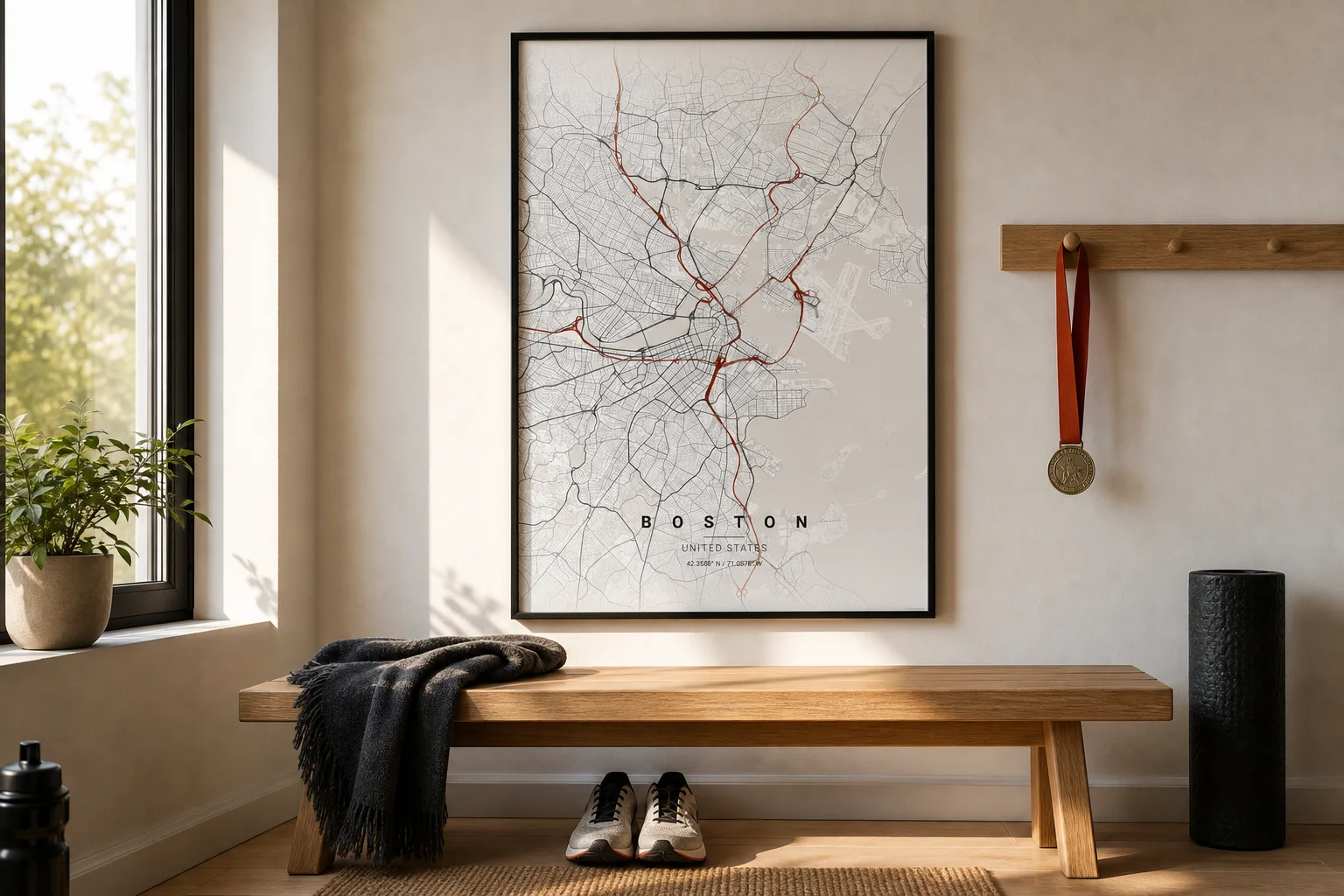
Boston’s Japanese-ink map above uses dark roads, restrained red accents, warm white ground, and a black frame. In the runner’s recovery room, the city reads clearly without turning the wall into sports memorabilia.
For the route itself, choose a color that remains visible across water, parks, and dense streets. Adjust thickness at the final poster size—not only while zoomed into the preview.
Add facts that belong to the day
Useful text can include race name, date, distance, finish time, or a short personal line. Keep the hierarchy clear. The map and route should still be the first things seen from across the room.
Start and finish markers help when they clarify the shape. If they make the line feel crowded, a single finish marker may be enough.
Make the frame part of daily life
A race poster can hang in a home office, entry hall, bedroom, or training corner. It does not need a wall filled with medals and bibs. One map, a simple frame, and perhaps the medal on a nearby peg can hold the memory without turning the room into a display case.
Choose frame material from the room: black metal for a crisp graphic treatment, oak for warmth, or walnut for a darker interior. The goal is a piece that can stay on the wall after the next race has been run.
A thoughtful gift for a runner
If you are making the poster for someone else, ask for the original activity file and confirm the details before printing. Route accuracy matters more than adding a surprise message.
The result is a record of effort with a clear sense of place—something that can be seen every day rather than stored with the gear.
Create a route poster while the course and its details are still fresh.