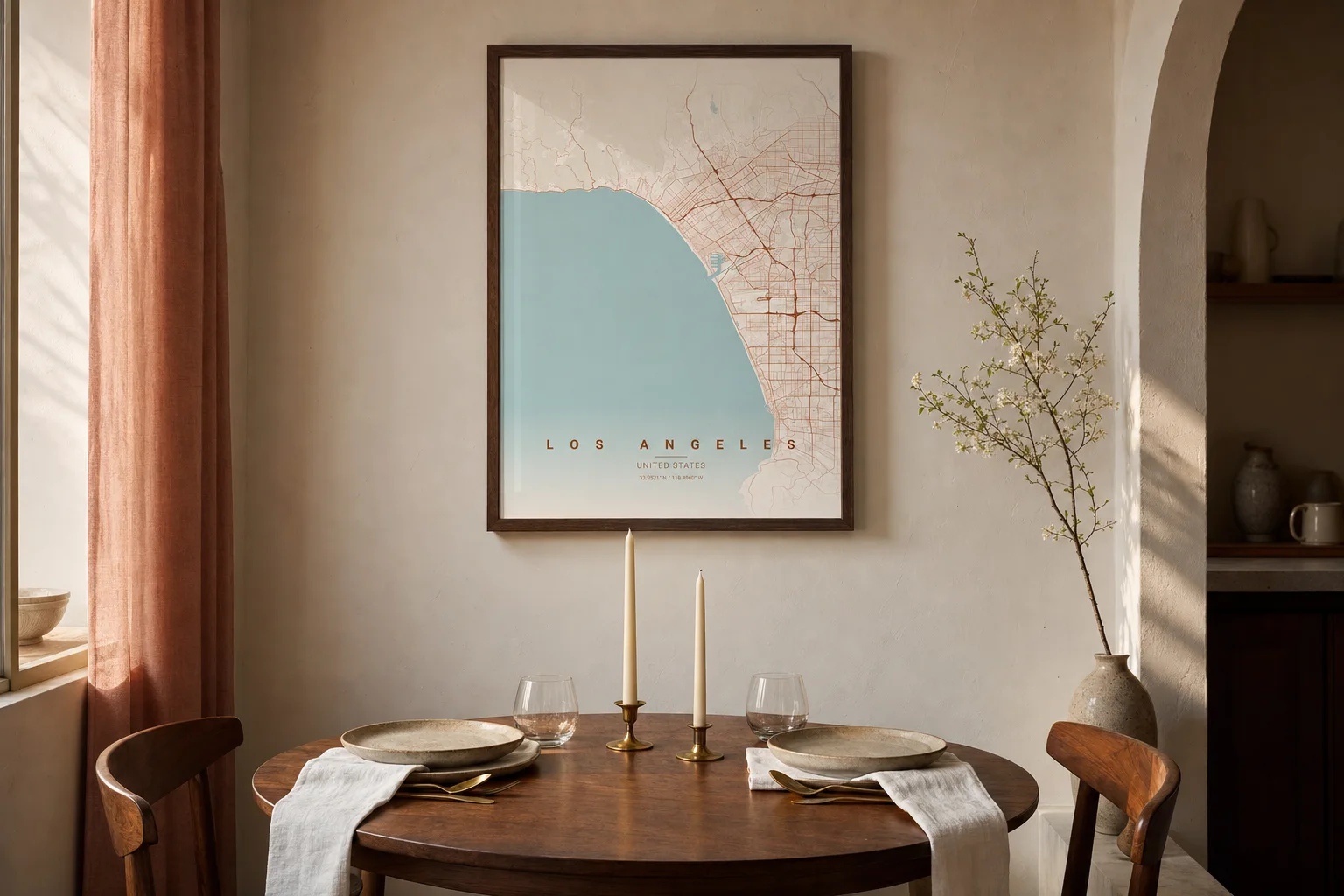
Bottom line: Choose one location with a clear shared meaning and let the geography carry the emotion.
Why it works: The map remains elegant to everyone else while holding a precise story for the two people who know it.
Try this: Start from the exact coordinate, set a neighborhood-scale radius, and keep the subtitle short enough to read from across the room.
Relationships accumulate places: the city where two people met, the corner of a first date, a station used every weekend, a borrowed apartment, or the street walked after an important decision. An anniversary map works best when it chooses one of those places rather than trying to summarize everything.
The Los Angeles dining room above keeps the idea quiet. A terracotta map, walnut frame, two place settings, and late sunlight are enough. No hearts or scripted slogans are needed.
Find the most specific useful location
Begin with the exact address or coordinate if it is known. Then decide whether the poster should reveal that point directly.
A small pin can mark the location. Leaving the pin out can make the piece more private, with the city pattern and coordinates carrying the meaning. Both approaches are valid; choose the one that will feel comfortable on the wall every day.
Use a radius that includes the surrounding routes and landmarks that made the moment possible. A first-date map may need the walk from the station to the restaurant, not only the building itself.
Match the shared home
The gift should belong to the room both people live in. Look at the existing timber, upholstery, metal, and wall color before selecting the theme and frame.
Terracotta and warm beige suit rooms with plaster, walnut, linen, or warm light. Monochrome blue and blueprint bring structure to cooler or more graphic interiors. A dark treatment can feel intimate in a well-lit room, while a pale map is easier to place in a smaller space.
Keep the language precise
Use the city or neighborhood name as the main title. A date, coordinate, or very short line can sit beneath it. Avoid generic declarations that could belong to any couple.
Specific language is more powerful: the month and year, the name of the neighborhood, or a phrase the couple already uses. Verify every detail before rendering; an anniversary piece should not depend on a corrected reprint.
Think beyond the day it is opened
The poster may be given over dinner, but it should be designed for the years afterward. Choose a common frame size, archival presentation, and a scale large enough for the map to remain legible.
For a first anniversary, the paper object has an obvious connection to tradition. For later anniversaries, the value is simpler: a shared location given a permanent place in the home.
The map does not need to explain the relationship. It only needs to hold the place where the story changed.
Create the anniversary map from the coordinate that still carries the memory.